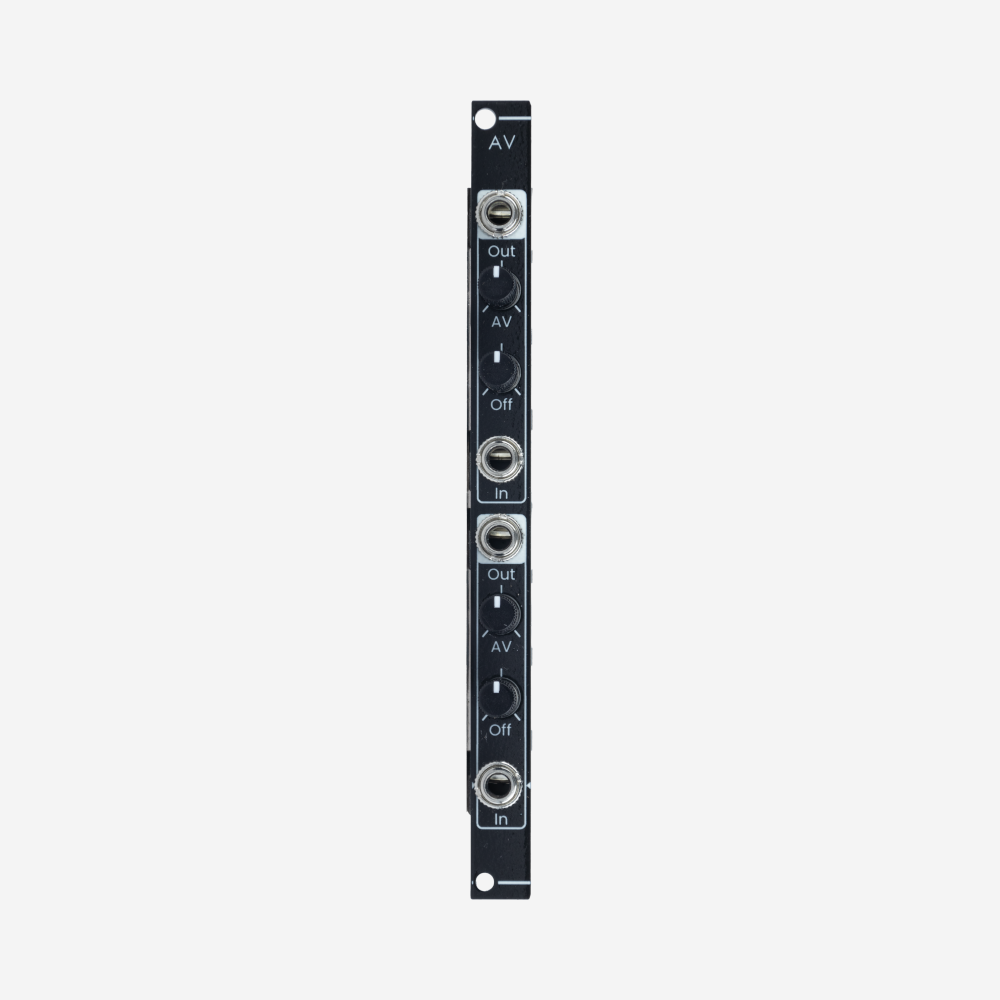
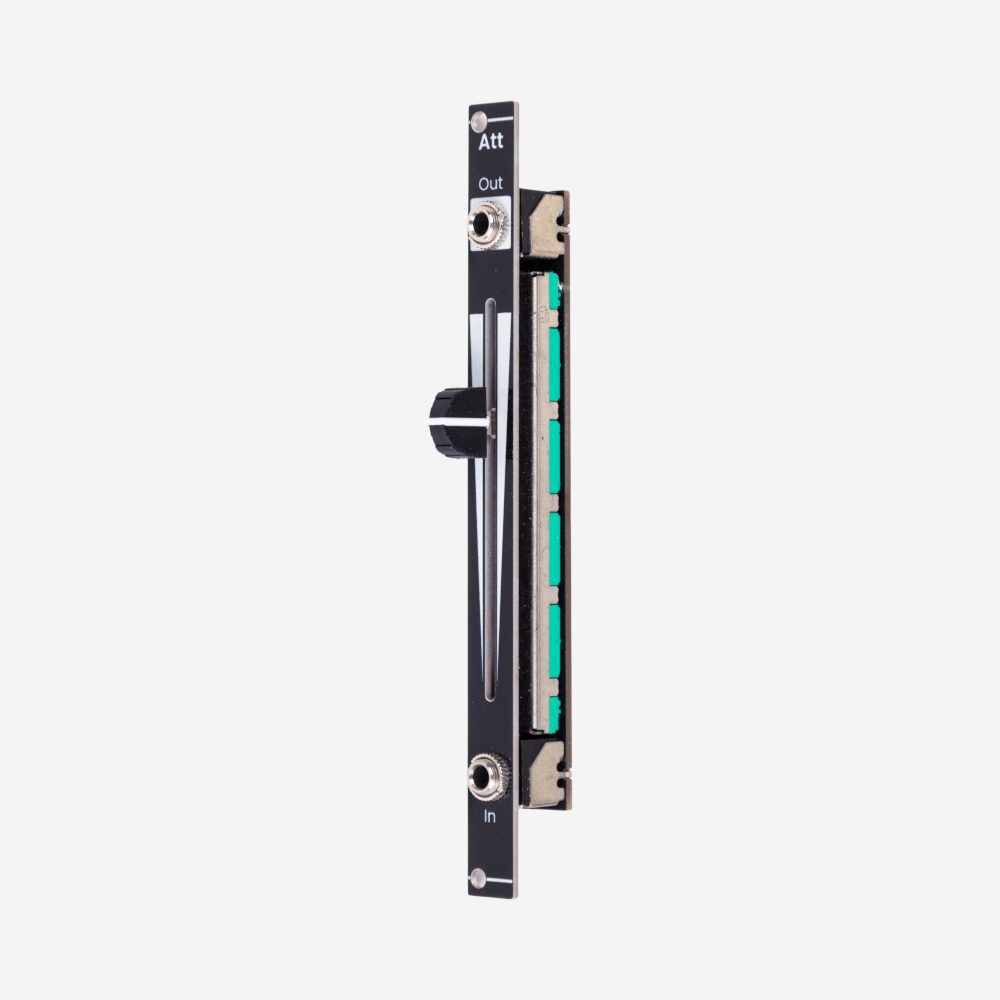
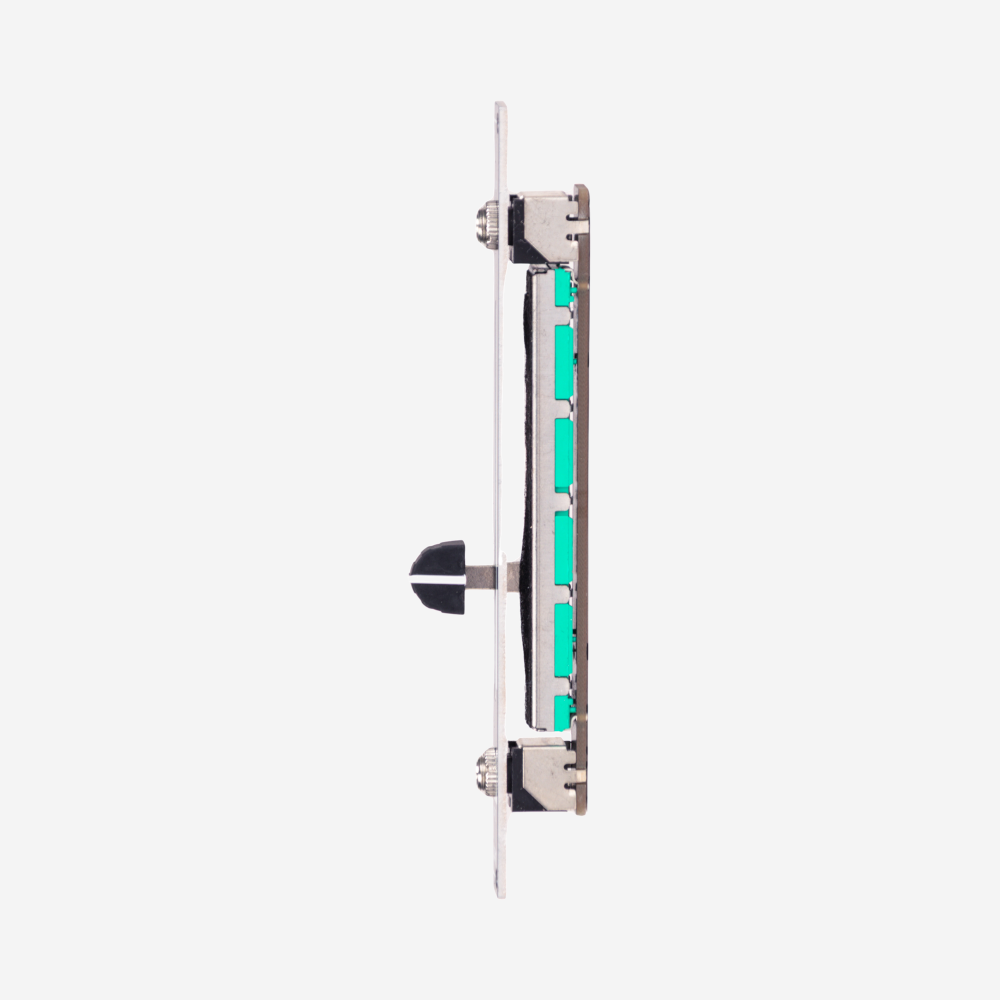
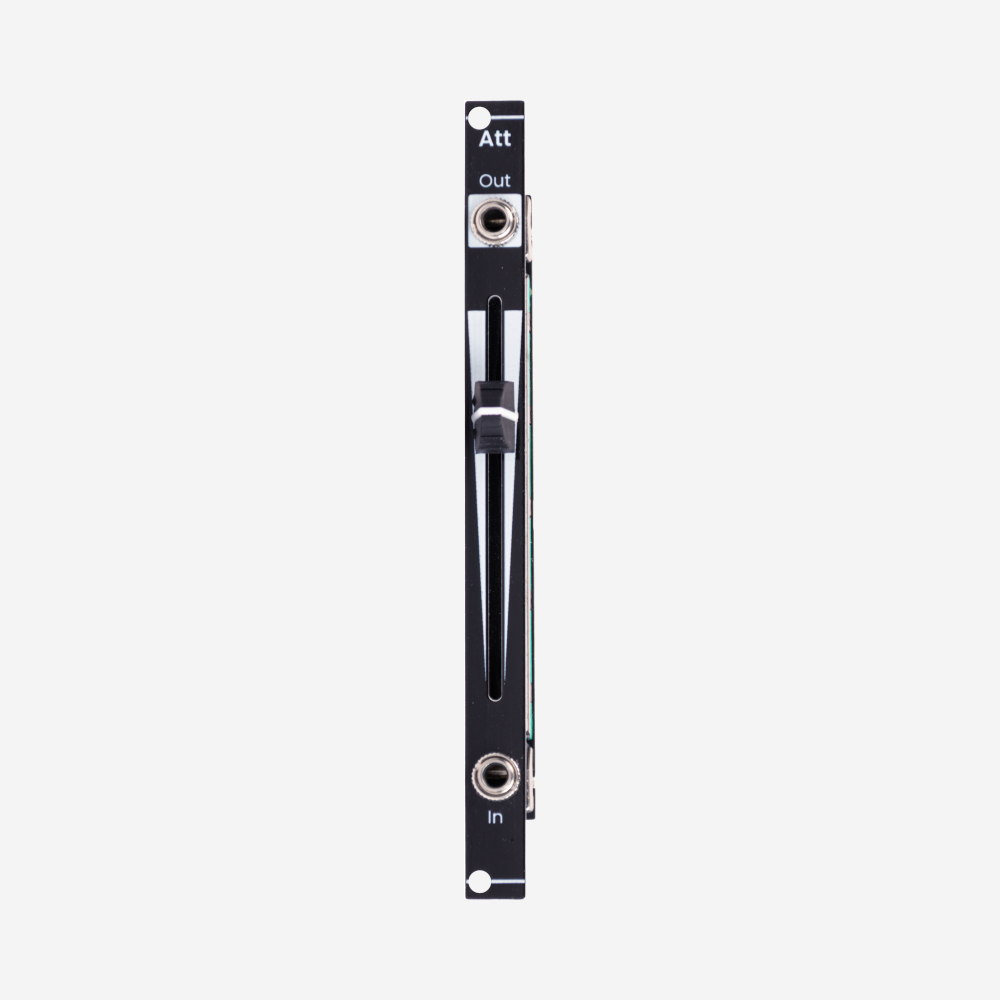
No VAT is charged under the small-business regulation pursuant to Section 19(1) of the German VAT Act (UStG). plus Shipping Costs
Slimline Passive Fader
Delivery time: 5 working days
- Module
- 2 × M2.5 × 9 mm Phillips-head screws
- 2 × M3 × 9 mm Phillips-head screws
Description
Slimline Passive Fader
Passive fader for direct attenuation of levels and CV in 2 HP
The Slimline Passive Fader is a deliberately simple utility: a signal enters, is attenuated by hand and leaves the module in a more controlled form. There is no CV control, no active gain and no menu layer. This directness is precisely what makes the fader useful when a patch does not need more complexity, but a tangible form of manual control.
Not every Eurorack task requires a VCA. Sometimes an LFO only needs to modulate with a little less depth, an audio signal needs to be reduced before an effect, or a control voltage needs to be introduced gradually during a performance. The Passive Fader provides a small control for exactly these situations. It behaves like a patch-level control: immediate, clear and free from additional logic.
Why use a passive fader?
A passive fader does not replace voltage-controlled dynamics. It does nothing automatically, follows no envelope and does not open in response to a gate. Its role is therefore unambiguous: it adds a hand movement to the patch. Adjustments that would otherwise require compensating for an overly sensitive input, an excessively strong LFO or an external mixer can be made directly in the rack.
For audio, this means straightforward level control. For CV, it means attenuating modulation before it affects a parameter too strongly. A filter can move more subtly, a VCA can respond less abruptly, and a waveshaper can remain within a controlled range. The fader therefore does not become an effect; it provides a musical scale between source and destination.
Directly in the signal path
Its value lies in where it is placed. A passive fader is particularly useful at the point where the decision is made: before an effects path, between an LFO and its destination, after a loud source or within a compact performance patch. A single hand movement immediately changes how strongly the signal affects the rest of the patch.
Because the circuit is passive, its function remains straightforward. The fader can attenuate, but it cannot amplify. Precise pitch-CV distribution, offsets or dynamic opening by control voltage require a different utility. For simple manual attenuation, however, this module provides exactly the required function without detours.
For small racks and performance patches
Very compact systems often lack precisely these unspectacular controls. A signal is fundamentally correct but too strong. A modulation works, but not at full depth. An effect should not be permanently present, but introduced by hand. The Slimline Passive Fader provides a small, clearly defined point of access for such adjustments.
The module is therefore less a sound source than a tool for playability. It helps you not only build a patch, but also handle it more sensitively while it is running.
The useful limits of passive circuitry
One of the strengths of the Passive Fader is that its limits are explicit. It adds no additional control scheme that first has to be understood within the patch. It is not a solution for automatic dynamics, but for deliberate manual attenuation. This makes it especially pleasant to use when a patch is already complex enough.
During a performance, the fader can take on a small but important role: gradually opening an effects path, reducing a modulation, fading out a drone or calming an overly dominant part of the sound. The intervention remains physical and easy to follow.
This immediacy is particularly valuable in a utility module. The fader explains itself within the patch: observe its position, understand the signal path and make the adjustment by hand.
It is also useful as a correction point. When a module responds too sensitively to a source, the entire signal path does not need to be rebuilt. The fader reduces the level in the connection and makes the useful range easier to perform.
Typical applications
- manually attenuate LFOs, envelopes or random CV
- reduce audio levels before effects, filters or mixers
- adjust modulation depth by hand during a performance
- bring excessive control voltages quickly into a useful range
- add direct passive control to compact systems
Additional information
| Weight | 0,04 kg |
|---|---|
| Dimensions | 15 × 2 × 5 cm |
| Width | 2HP |
| Depth | 14mm |
| Current draw +12 V / −12 V / +5 V | 0mA / 0mA / 0mA |
Product safety
Manufacturer information
CatSynth Dr. Zülch
Beethovenstr. 17
D-76689 Karlsdorf-Neuthard


Reviews
There are no reviews yet.