


No value added tax is charged, as these are small businesses according to § 19 (1) UStG. plus Shipping Costs
Slimline Sequencer
Delivery time: 5 working days
- Module
- Ribbon cable 16-pin/10-pin, 30 cm
- 2x M2.5×9 Phillips screw
- 2x M3x9 Phillips screw
Description
Slimline Sequencer
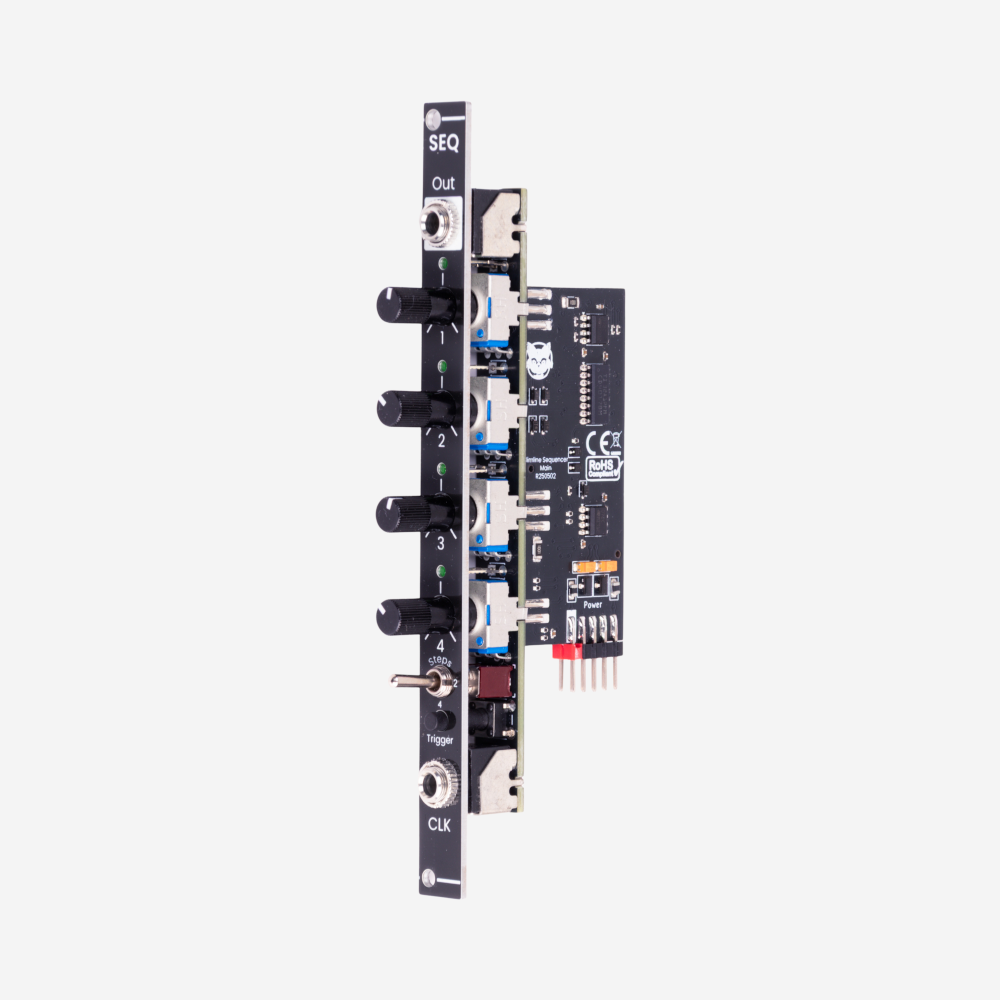
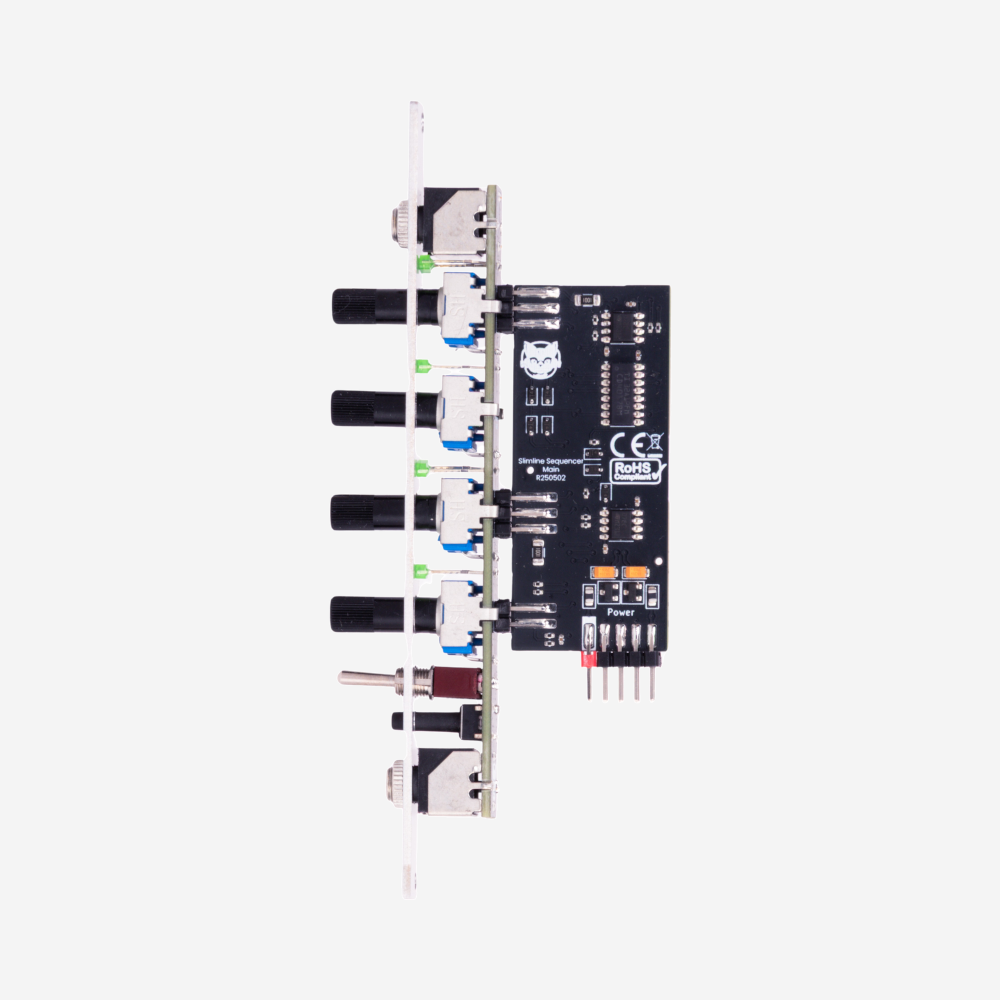
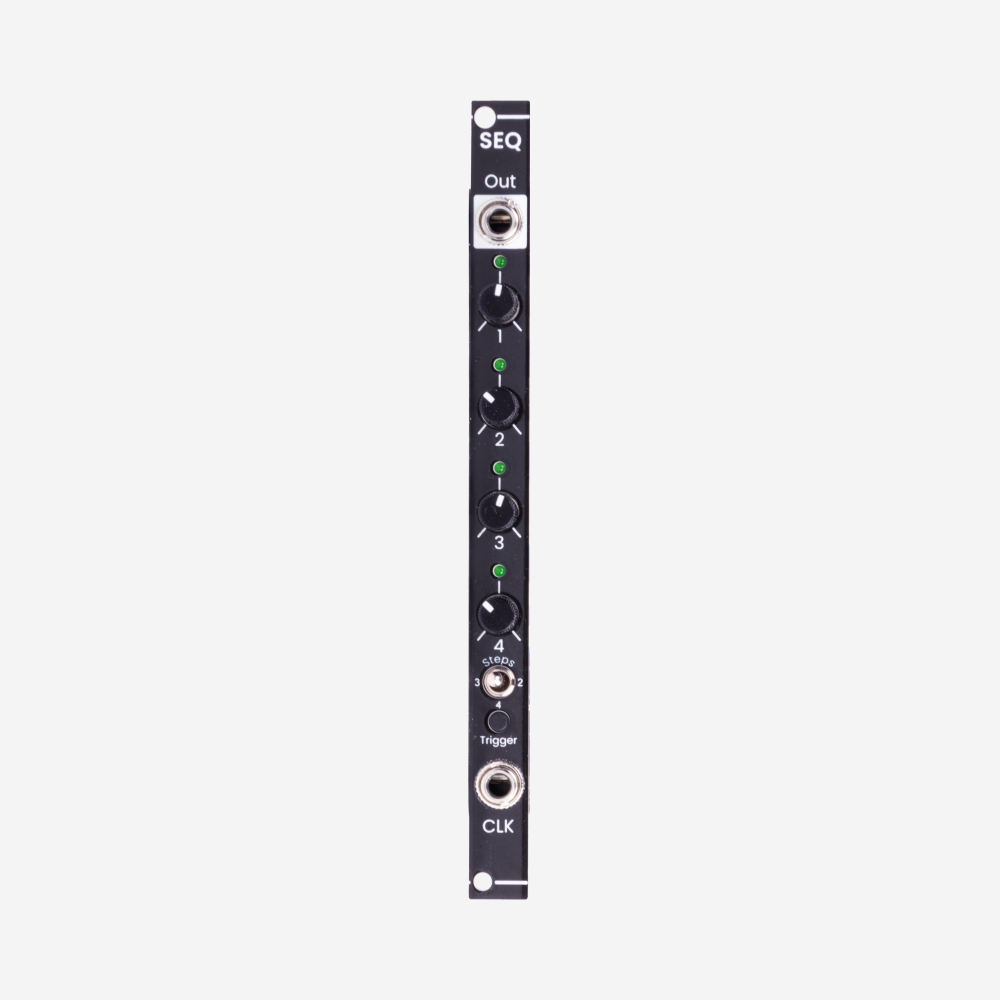
4-step CV sequencer with switchable step count & manual trigger for Eurorack in 2HP
Create rhythmic patterns and melodic structures where Eurorack is the most fun: right in the patch, right on the front panel – and in the most compact format.
The Slimline Sequencer is a deliberately streamlined 4-step CV sequencer that gives you exactly what you constantly need in practice in only 2HP: a quickly adjustable voltage sequence that loops cleanly, can be “nudged” live, and becomes surprisingly musical with just a few turns.
Whether as a mini melody source, as cyclic modulation for filters/VCAs, or as a time-keeping impulse for animated patch movements – this module brings pattern thinking to any rack without hogging space or attention.
In Eurorack, magic often comes not from complex menus, but from small, direct tools: a few steps, a clock signal, a few destination modules – and suddenly a static sound source turns into a living system.
That’s exactly where the Slimline Sequencer comes in. It’s not a “workstation” sequencer that does everything, but an always-on utility for sequences you build quickly, change on the fly, and just as quickly shift into new roles.
That makes it ideal for live performances, spontaneous sessions, and patches where you want to run several small sequence layers in parallel.
Why a mini sequencer?
- Instant patterns without a menu: set four steps, clock it, done – perfect for quick patch ideas
- CV sequences for anything: pitch, filter sweeps, waveshaper drive, panning, effect parameters, “macro” modulation
- Rhythmic structure in your system: short loops give your patch a backbone – even when everything else is freely floating
2HP compact – sequencing where you need it
In dense Eurorack setups every HP counts.
The Slimline Sequencer fits even the smallest racks, making it perfect as an additional sequence lane you can drop into an existing patch “on the side”.
Instead of reprogramming your main sequencer or building a complex scene, you place this mini sequencer exactly where you need motion right now: on a filter, on an oscillator’s timbre input, in a delay feedback path, or as a small repeating CV gesture for a drum voice.
The big advantage is immediacy: four knobs, four steps – no abstraction.
That invites you to treat sequences not as a “finished composition”, but as patch material.
Turn step 2 and the patch reacts instantly. Reduce the step count and the groove feel flips.
Those small interventions are often the difference between “it runs” and “it lives” in modular.
4-step CV sequencer – small, but musical
Four steps might sound like “very little”.
In practice, it’s a surprisingly productive length: short enough to stay understandable, long enough to form real motifs.
You can build simple melodic cells (e.g. root–fifth–octave–return), set up filter sweeps as recurring “gestures”, or use the sequencer as a controlled modulation source for parameters that work especially well in a loop: resonance, fold, FM amount, sample rate, VCAs, or effect mix.
And because it’s a CV sequencer, you’re not limited to pitch.
A 4-step loop can just as well control rhythmic dynamics, move panning, or step through several “states” of a sound one after another.
Especially in combination with a quantizer (for pitch) or a slew limiter (for smoother transitions), four steps become a very “big” source.
Switchable step count – 2, 3 or 4 steps for more groove
This is where it gets really interesting: you can switch the active step count and deliberately play with loop lengths.
A 4-step pattern is stable and “square” – ideal as a foundation.
A 3-step loop, on the other hand, immediately creates friction against 4/4 clocks, because it shifts over several bars: the pattern “walks” relative to kick/snare or other modulation cycles.
A 2-step loop can act like an alternating switch: A/B movement, call/response, two states for timbre or dynamics.
This switchability turns the Slimline Sequencer into a tool for odd accents and “living repetition” without having to program complex polyrhythms.
Set four steps once – and switching the length creates new variations that you can use live like a performance element.
Manual trigger – perform, test, improvise steps
The integrated trigger button is more than a convenience feature.
It turns the sequencer into a performable module: you can advance steps manually, set accents, deliberately step out of time, or fire individual “scenes” during breaks.
Especially in live situations this is extremely helpful, because you don’t always need a clock patched in to test an idea or to push a modulation to the next position on purpose.
In the studio the button is just as practical: you can check CV paths, fine-tune destination modules, or “click through” a sequence without everything already running in the background.
That dramatically reduces patch frustration – and turns the sequencer into a tool you like to use often because it feels immediate.
Typical uses
- Mini melodies: 4-step CV into a quantizer, then into VCO pitch – immediately playable motifs
- Filter sweeps: cyclic CV on cutoff/resonance for recurring gestures
- Polyrhythmic modulation: a 3-step loop against a 4/4 clock for drifting accents
- A/B switch: 2-step mode for two sound states (e.g. drive low/high)
- Performance tool: trigger steps by hand, shape breaks, “nudge” transitions
- Patch debugging: test CV paths and set target ranges – without an external clock
The Slimline Sequencer is exactly what a good 2HP utility should be: small, fast, musical – and so versatile that after you install it you’ll hardly want to take it out of the rack again.
Additional information
| Weight | 0,08 kg |
|---|---|
| Dimensions | 15 × 2 × 10 cm |
Product safety
Manufacturer information
CatSynth Dr. Zülch
Beethovenstr. 17
D-76689 Karlsdorf-Neuthard
Related products


Reviews
There are no reviews yet.